

Airline Pilot Licences Explained: PPL, CPL, ATPL, MPL & Ratings
Updated 9 October 2026 | A comprehensive guide to UK and European airline pilot licensing
If you’re considering becoming an airline pilot, one of the first things you’ll encounter is a confusing collection of abbreviations: PPL, CPL, ATPL, MPL, IR, MCC and UPRT, to name just a few.
Understanding what these qualifications mean, how they fit together and which ones you actually need to fly for an airline can be surprisingly difficult when you’re new to aviation.
The good news is that the process becomes much easier to understand once you realise that pilot licences, aircraft ratings and training courses are different things. Each serves a particular purpose, and together they establish what you’re qualified to fly and under which conditions.
In this guide, we’ll explain the different pilot licences, how to obtain them, the meaning of a frozen ATPL, and the qualifications needed to become an airline First Officer or Captain.
We’ll also look at the different training routes, including integrated, modular and Multi-Crew Pilot Licence (MPL) programmes, and explain what happens after you secure your first airline job.
The article concentrates primarily on UK CAA and EASA licensing, which share many principles but have some important differences.
What Licence Do You Need to Become an Airline Pilot?
For a typical airline First Officer position in the UK or Europe, there are two principal licensing pathways.
Traditional CPL / ATPL Route
Complete professional flight training leading to a Commercial Pilot Licence (CPL), appropriate instrument rating, ATPL theoretical knowledge credit and multi-crew training.
This combination is commonly described as a frozen ATPL.
Multi-Crew Pilot Licence (MPL)
Complete an approved MPL training programme designed around operating as a co-pilot in a multi-crew commercial aircraft.
These programmes are normally developed in association with an airline or airline-specific training pathway.
Both routes can lead to employment as an airline First Officer, provided you meet the applicable licensing, type rating, medical, training and operator requirements.
Important: A frozen ATPL is not an officially issued licence. It is an informal term describing a pilot who has completed the relevant qualifications and ATPL theory but has not yet met the requirements for a full ATPL.
In This Guide
- Understanding the different pilot licences
- The routes to becoming an airline First Officer
- Private Pilot Licence (PPL)
- Commercial Pilot Licence (CPL)
- ATPL theory and the frozen ATPL
- Instrument ratings, multi-engine training and MCC
- Multi-Crew Pilot Licence (MPL)
- The full Airline Transport Pilot Licence
- Type ratings, base training and line training
- UK CAA versus EASA licences
- Frequently asked questions
Understanding the Different Pilot Licences
Before looking at the individual qualifications, it helps to understand what each licence broadly allows you to do.
These descriptions relate to aeroplane licences. The abbreviation (A) simply indicates that the licence is for aeroplanes rather than helicopters or another category of aircraft.
| Licence | What It Allows | Relevance to Airlines |
|---|---|---|
| PPL(A) Private Pilot Licence | Private, non-commercial flying within the relevant privileges and ratings. | Common starting point for modular training, but not required as a separate licence on every training route. |
| CPL(A) Commercial Pilot Licence | Commercial flying within the privileges of the licence and relevant ratings. | The main professional licence held by pilots following the traditional airline training route. |
| MPL(A) Multi-Crew Pilot Licence | Operation as a co-pilot in qualifying multi-pilot commercial air transport operations. | Alternative airline-focused training pathway. |
| ATPL(A) Airline Transport Pilot Licence | The highest level of aeroplane pilot licence, including command privileges in commercial air transport, subject to relevant qualifications. | Normally required to act as Captain of a multi-pilot commercial air transport aircraft. |
There are also recreational licences, including the Light Aircraft Pilot Licence (LAPL) and certain UK national licences. These have more limited privileges and are not, by themselves, professional airline qualifications.
It is also worth understanding the distinction between a licence, a rating and a training course certificate.
Licence, Rating or Course – What’s the Difference?
Pilot licence: Establishes your general level of flying privileges. Examples include a PPL, CPL, MPL or ATPL.
Rating: Provides additional privileges associated with a particular aircraft class, aircraft type or form of flying. Examples include an Instrument Rating (IR), Multi-Engine Piston (MEP) class rating or Airbus A320 type rating.
Training course or certificate: Demonstrates completion of specific training required for a particular stage of your career. Examples include Multi-Crew Cooperation (MCC) and Advanced Upset Prevention and Recovery Training (UPRT).
Consequently, a pilot may hold a CPL while also having an instrument rating, aircraft class rating, ATPL theoretical knowledge credit and certificates confirming completion of other required courses.
The Route to Becoming an Airline First Officer
There isn’t one universal training route that every airline pilot must follow.
In the UK and Europe, aspiring airline pilots commonly pursue one of three pathways: integrated training, modular training or an airline-linked MPL programme.
These routes can lead towards similar career objectives, but their training structure, qualification sequence and commercial arrangements differ.
Integrated Training
Complete a structured, continuous professional training programme through an Approved Training Organisation (ATO).
The programme brings together theoretical knowledge, practical flight training and the required professional qualifications.
Typical outcome: CPL with relevant instrument privileges, ATPL theory credit and associated multi-crew training.
You do not necessarily receive a separate PPL during an integrated professional course.
Modular Training
Complete the required qualifications progressively, potentially using different approved training organisations.
You would normally begin with a PPL, build flying experience and then complete the relevant professional theory, CPL, ratings and courses.
Typical outcome: Broadly the same CPL-based professional qualification package as the traditional integrated route.
The sequence can be more flexible, although each individual course has its own prerequisites.
MPL Training
Complete an approved training programme designed specifically for multi-crew commercial airline operations.
Training normally involves substantial aircraft and simulator instruction, with an emphasis on multi-crew procedures and airline operations.
Typical outcome: An MPL with the appropriate aircraft qualifications for employment as a co-pilot.
The initial privileges are more specialised than those associated with a CPL.
For a more detailed comparison of the first two routes, see our Integrated vs Modular Flight Training Guide.
Example: The Traditional Airline Pilot Training Pathway
The following provides a simplified illustration of how somebody might progress from having no previous flying experience to becoming an airline First Officer.
↓
↓
↓
↓
↓
This is an illustrative pathway rather than a fixed regulatory sequence. Training order and course requirements depend on the approved programme, qualifications already held and applicable licensing rules.
Some trainees complete the majority of these elements within one integrated programme, while others complete them at different stages through modular training.
The airline-specific type rating and line training normally follow recruitment, although airlines differ in their entry requirements and how the costs are arranged.
Before You Start: The Class 1 Medical Certificate
Before committing substantial money to professional flight training, one of the most important steps is to establish whether you meet the medical requirements for a commercial pilot licence.
In the UK and EASA systems, a Class 1 medical certificate is required for the exercise of professional CPL, MPL and ATPL privileges.
An initial assessment includes a review of your medical history and examinations covering areas such as vision, hearing, cardiovascular health and general medical fitness.
Medical certification requirements are detailed, and some conditions require further assessment rather than resulting in an automatic refusal.
Because professional flight training can involve a considerable financial commitment, we strongly recommend obtaining the relevant initial Class 1 medical before making a major non-refundable investment.
Class 1 vs Class 2 Medical
Class 1: Required for professional CPL, MPL and ATPL privileges.
Class 2: Generally appropriate for private flying under a PPL, subject to the applicable licensing and medical requirements.
If your ambition is to become an airline pilot, meeting the requirements for a PPL medical does not necessarily establish that you will meet the professional Class 1 standard.
For more information, see our Airline Pilot Medical Requirements Guide.
Private Pilot Licence (PPL) Explained
The Private Pilot Licence (PPL) is one of the most familiar pilot qualifications and is often the first licence obtained by somebody learning to fly.
A PPL allows you to act as pilot in command of an aircraft in non-commercial operations, within the privileges of the licence, ratings and applicable operating rules.
For example, somebody holding a PPL with an appropriate Single-Engine Piston (SEP) class rating may fly a light aircraft such as a Cessna 172 or Piper PA-28 privately.
However, a PPL does not normally permit you to operate commercial passenger flights for payment. Certain specific exceptions exist, such as authorised instruction and examining privileges, but it is fundamentally a private pilot licence.
What Does PPL Training Involve?
During PPL training, you’ll learn the fundamental skills required to operate an aircraft safely.
Training normally includes:
- Aircraft handling and the principles of flight.
- Take-offs, landings and circuit procedures.
- Navigation and flight planning.
- Radio communication.
- Aircraft performance and limitations.
- Weather interpretation and operational decision-making.
- Emergency procedures and basic instrument awareness.
- Supervised solo flying and cross-country navigation.
You’ll also complete theoretical knowledge examinations and, once you’ve reached the required standard, a practical skill test with an authorised examiner.
How Many Flying Hours Are Required for a PPL?
This is an example of why it’s important to distinguish between the UK CAA and EASA licensing systems.
| Licensing System | Standard Minimum | Important Information |
|---|---|---|
| UK CAA | 40 hours | Current CAA guidance allows a reduction to 35 hours under specified approved ATO arrangements. Some simulator credit is permitted. |
| EASA | 45 hours | Includes specified dual and supervised solo training requirements, with limited approved simulator credit. |
Both systems include supervised solo flying and cross-country requirements. Previous experience or other qualifications may provide credit in certain circumstances.
The published figures represent minimum training requirements, not a guarantee that every student will be ready for their skill test after precisely that number of hours.
Some students need additional flying to achieve the required standard, which should be considered when budgeting for training.
The minimum age for issue of a PPL(A) is generally 17 years in these systems.
Official guidance: UK CAA PPL requirements.
Do You Need a PPL to Become an Airline Pilot?
Not necessarily.
If you choose the modular route, obtaining a PPL is normally an essential early stage of your training because it forms part of the prerequisites for subsequent modular professional courses.
However, integrated ATP training programmes are designed to take students through a structured course towards professional qualifications. You do not necessarily need to obtain a separate PPL before joining or completing the programme.
Likewise, an MPL programme does not normally issue a PPL as part of its standard licensing outcome.
A PPL can nevertheless be a useful qualification for somebody who wants to gain flying experience before deciding whether to pursue professional training.
Commercial Pilot Licence (CPL) Explained
The Commercial Pilot Licence (CPL) is a professional flying licence and a major milestone for pilots training through the traditional route towards airline employment.
It establishes privileges to undertake commercial flying within the limits of the licence, relevant aircraft ratings and applicable operating regulations.
The important difference between a PPL and CPL is that a CPL provides professional flying privileges. However, holding a CPL does not mean you are automatically qualified to fly any commercial aircraft or carry out any airline operation.
For example, operating a commercial jet as a First Officer also requires the appropriate instrument privileges, aircraft type rating, training and operator qualifications.
What Can You Do With a CPL?
Depending on your ratings, experience and the applicable operating rules, a CPL can allow you to undertake commercial flying activities.
These may include certain single-pilot commercial operations or acting as a co-pilot in commercial air transport, subject to the relevant restrictions and additional qualifications.
A CPL holder may also pursue further qualifications and experience that support careers in areas such as flight instruction, aerial work or airline operations.
The precise privileges depend on the aircraft, operation and requirements of the relevant licensing authority.
What Does CPL Training Involve?
CPL training develops your flying skills beyond the standard expected of a private pilot.
Greater emphasis is placed on accuracy, consistency, aircraft handling, planning, professional airmanship and decision-making.
You’ll be expected to demonstrate a higher standard of performance while managing increasingly demanding flying exercises.
The training includes a practical CPL skill test with an authorised examiner.
How Many Flying Hours Do You Need for a CPL?
The requirements depend on the training route.
Under current UK CAA guidance, a modular CPL(A) applicant must normally have at least 200 hours of total flight time before completing the CPL skill test, including specified pilot-in-command and cross-country experience.
A modular CPL course also has entry prerequisites, including a PPL and a minimum amount of previous flying experience.
Integrated CPL training follows a different approved syllabus. For example, a standalone integrated CPL course has a minimum of 150 hours of flight training under the applicable UK CAA requirements, while integrated professional programmes combining a CPL and instrument rating have their own requirements.
These figures should not be confused with the total duration or flying hours of every integrated airline pilot training programme.
The minimum age for issue of a CPL is 18 years, and professional privileges require a valid Class 1 medical.
Official guidance: UK CAA Commercial Pilot Licence requirements.
A CPL Alone Is Not an Airline Qualification Package
Although a CPL is a professional licence, a newly qualified pilot who wants to operate a commercial jet will normally need several additional qualifications.
These include appropriate instrument privileges, ATPL theoretical knowledge credit, multi-crew training and an aircraft type rating.
This is where the commonly used expression frozen ATPL comes in.
What Is a Frozen ATPL?
The term frozen ATPL is used extensively throughout the aviation industry, particularly by flight schools and airline recruiters.
However, it is important to understand that a frozen ATPL is not a separate licence issued by the CAA or EASA.
It is an informal description of a pilot who has completed the relevant professional training and ATPL theoretical knowledge requirements but has not yet qualified for the issue of a full Airline Transport Pilot Licence.
Under the traditional aeroplane route, this usually involves holding a CPL with a multi-engine instrument rating, having passed the ATPL theoretical examinations and completing the required multi-crew training.
Advanced UPRT is also a prerequisite for the first relevant multi-pilot type rating, unless an applicable approved training arrangement or exemption provides otherwise.
What Qualifications Are Associated With a Frozen ATPL?
A typical airline-ready CPL-based qualification package includes:
- CPL(A): Commercial Pilot Licence.
- ATPL theoretical knowledge credit: Successful completion of the required ATPL theory examinations.
- Multi-engine privileges: The relevant aircraft class or type qualification.
- Multi-engine Instrument Rating (IR): Instrument flying privileges appropriate to the intended operation.
- MCC or APS MCC: Multi-crew training, completed separately or within an approved integrated programme.
- Advanced UPRT: Required training before entering the first applicable multi-pilot type rating course, subject to the relevant rules.
- Class 1 medical: Valid medical certification for professional flying privileges.
An aircraft type rating and airline-specific training are then required before operating the relevant aircraft in commercial airline service.
A pilot holding these qualifications may be eligible to apply for suitable low-hour First Officer vacancies, depending on the airline’s recruitment requirements.
Completing the training does not, by itself, guarantee employment or establish that every airline’s entry criteria have been met.
ATPL Theoretical Knowledge Examinations
A substantial part of professional pilot training involves studying the theoretical subjects associated with the Airline Transport Pilot Licence.
In the current UK and EASA aeroplane examination structure, students generally complete 13 ATPL theoretical knowledge examinations, with a minimum pass mark of 75% in each examination.
The subjects cover:
- Air Law.
- Aircraft General Knowledge – Airframe, Systems and Powerplant.
- Aircraft General Knowledge – Instrumentation.
- Mass and Balance.
- Performance.
- Flight Planning and Monitoring.
- Human Performance.
- Meteorology.
- General Navigation.
- Radio Navigation.
- Operational Procedures.
- Principles of Flight.
- Communications.
The theoretical syllabus is extensive, covering the knowledge required to understand aircraft operation, navigation, meteorology, human performance, flight planning and aviation regulations.
Students following an integrated route normally complete the theory as part of their professional training programme. Modular students may complete the approved theoretical course separately, including through suitable distance-learning arrangements.
Passing these examinations does not mean that you immediately hold a full ATPL. It establishes theoretical knowledge credit that can be used towards the relevant professional licensing pathway, subject to the applicable validity requirements.
Do ATPL Theory Passes Expire?
ATPL theory passes are subject to regulatory validity rules. The precise arrangements depend on the licensing system, the licence or rating being applied for, and the qualifications subsequently maintained.
For example, the UK CAA states that ATPL(A) theoretical knowledge credit remains valid for ATPL issue for seven years from the last validity date of an aeroplane instrument rating entered in the licence, subject to the applicable rules.
This is one reason why students should understand examination validity and the sequence of their training before committing to a modular programme.
It’s also important not to confuse the validity of theoretical examination credit with the validity of the pilot’s licence, instrument rating or medical certificate. These are separate requirements.
Instrument Ratings, Multi-Engine Training & Additional Qualifications
Professional airline training involves more than obtaining a CPL and passing theoretical examinations.
Pilots also need additional qualifications that establish the privileges to operate particular aircraft and conduct instrument or multi-crew operations.
Instrument Rating (IR)
An Instrument Rating (IR) allows a suitably qualified pilot to operate under Instrument Flight Rules (IFR), subject to the applicable privileges and limitations.
Instrument flying is fundamental to commercial airline operations, where flights are routinely conducted using instrument procedures and may involve cloud, poor visibility or complex controlled airspace.
During instrument training, pilots learn to control and navigate the aircraft using its instruments, follow IFR procedures and manage instrument approaches, departures and missed approaches.
The training develops accuracy, situational awareness, workload management and the ability to fly safely without relying on external visual references.
A full instrument rating is a significant additional qualification and requires specific theoretical and practical training followed by a skill test.
It is important to distinguish IFR, which refers to the rules under which a flight is conducted, from IMC, which refers to instrument meteorological conditions. IFR flights can take place in good weather, while an instrument rating provides privileges relevant to operating in conditions where visual references may be insufficient.
Single-Engine vs Multi-Engine Instrument Rating
An instrument rating can provide privileges for different classes or types of aircraft, depending on the training and qualification held.
Single-engine instrument privileges apply to the relevant single-engine aircraft.
Multi-engine instrument privileges apply to appropriately qualified multi-engine aircraft and are particularly relevant to the traditional airline pilot licensing pathway.
The multi-engine instrument training includes operating under IFR while managing the additional complexity of a multi-engine aircraft, including relevant asymmetric flight and abnormal situations.
A pilot preparing for a typical commercial airline First Officer position through the CPL route will normally need a multi-engine IR.
Official guidance: UK CAA Instrument Rating requirements.
Multi-Engine Piston (MEP) Rating
A Multi-Engine Piston (MEP) class rating qualifies a pilot to operate appropriate multi-engine piston aeroplanes.
For example, a student progressing towards professional qualifications may undertake training on a twin-engine aircraft before completing a multi-engine instrument rating.
MEP training introduces the handling and operational considerations associated with aircraft having more than one engine, including the implications of an engine failure.
However, a multi-engine class rating and an instrument rating are not the same qualification.
One establishes privileges relevant to operating the aircraft class; the other establishes instrument flying privileges.
Multi-Crew Cooperation (MCC)
Most newly qualified pilots complete much of their practical training in light aircraft operated by a single pilot.
Airline operations are very different. On an aircraft such as a Boeing 737 or Airbus A320, the flight crew normally consists of a Captain and First Officer working together using clearly defined procedures.
The Multi-Crew Cooperation (MCC) course helps bridge this gap by introducing the knowledge and behaviours required to operate effectively in a multi-pilot environment.
Training places particular emphasis on:
- Communication and teamwork.
- Crew Resource Management.
- Leadership and effective followership.
- Situational awareness.
- Workload management.
- Decision-making.
- Monitoring and cross-checking.
- Multi-crew standard operating procedures.
The practical element normally takes place in an approved flight simulation training device representative of a multi-crew aircraft.
Under the relevant UK CAA rules, a conventional MCC course includes theoretical instruction and a prescribed amount of practical multi-crew training. The minimum practical training differs in certain integrated and combined-course arrangements.
What Is an APS MCC?
The Airline Pilot Standards Multi-Crew Cooperation course (APS MCC) builds upon traditional MCC training with additional emphasis on preparing students for airline operations.
It incorporates more advanced swept-wing jet training, airline operational scenarios and a final assessment.
Compared with a conventional MCC, the APS MCC involves additional practical training and a more structured airline-oriented assessment standard.
Some airlines prefer or specifically request APS MCC training from applicants, although requirements vary between operators and recruitment campaigns.
The APS MCC remains a training course rather than a separate pilot licence.
MCC or APS MCC – Which Should You Choose?
If you’re completing modular training and intend to apply to airlines, it’s worth investigating the APS MCC courses available to you.
However, the quality of the training organisation, instructor experience, training device, course structure and airline entry requirements all deserve consideration.
The most expensive course is not automatically the best option, and you should check the requirements of your intended employers before making a decision.
For a detailed explanation, see our MCC vs APS MCC Comparison Guide.
Advanced Upset Prevention & Recovery Training (UPRT)
Upset Prevention and Recovery Training (UPRT) develops the knowledge and practical skills needed to help pilots recognise, avoid and recover from aircraft upset conditions.
An aircraft upset generally involves an unintended aircraft attitude or flight condition outside the normal operating envelope.
UPRT addresses important aspects of aircraft handling, situational awareness and pilot response to unexpected or unusual flight conditions.
The advanced UPRT course includes a minimum of five hours of theoretical instruction and three hours of dual flight instruction in an aeroplane under the relevant EASA framework.
Advanced UPRT is required before commencing a first applicable multi-pilot type rating course, subject to the specific requirements and any approved exemptions or integrated arrangements.
It’s important to understand that UPRT is not a separate pilot licence, and it doesn’t grant additional operational flying privileges by itself.
Official guidance: EASA Upset Prevention and Recovery Training.
Multi-Crew Pilot Licence (MPL) Explained
The Multi-Crew Pilot Licence (MPL) provides an alternative pathway into commercial airline flying.
Rather than following the traditional sequence of individual private and commercial licences, MPL training is designed around the competencies required to operate as a co-pilot in a multi-pilot commercial aircraft.
MPL courses are normally associated with a particular airline training programme, with training delivered through an approved organisation.
The syllabus combines fundamental flying skills with extensive simulator training, multi-crew procedures and airline-oriented operational training.
What Can You Do With an MPL?
An MPL holder can exercise co-pilot privileges in qualifying multi-pilot commercial air transport operations, subject to the licence, aircraft qualifications and applicable requirements.
Unlike a CPL, an MPL does not automatically include the privileges of a PPL.
Consequently, somebody who has completed an MPL programme may be qualified to operate as a First Officer on a commercial aircraft but not independently licensed to fly a light single-engine aircraft for recreational purposes.
Additional training and assessment can be undertaken to obtain other privileges, including PPL, CPL or single-pilot instrument privileges where the applicable requirements are met.
What Are the Advantages of an MPL?
The principal advantage of an MPL is that the training is specifically designed around multi-crew airline operations.
Students are introduced to airline procedures, crew coordination and simulator-based training as part of a structured pathway towards operating a commercial aircraft.
Where the programme is genuinely linked to a sponsoring airline, the training may also be closely aligned with that operator’s procedures and aircraft requirements.
However, the commercial arrangements vary considerably. Being selected for an MPL programme does not automatically mean that training is fully funded or that future employment is guaranteed.
What Are the Potential Disadvantages of an MPL?
One consideration is that the initial privileges of an MPL are more specialised than those of the traditional CPL route.
This can be particularly relevant if a trainee wishes to change career direction or if the intended airline employment does not materialise.
For example, a pilot holding a CPL with appropriate ratings may have access to a wider range of potential flying activities than a pilot holding an MPL without additional single-pilot privileges.
An MPL holder may also need further training and licensing action to transition into other types of flying.
Before joining an MPL programme, it’s therefore important to understand the contractual arrangements, funding obligations, what happens if training is interrupted and the options available if the intended airline position does not become available.
Official guidance: UK CAA Multi-Pilot Licence requirements.
MPL vs Traditional Frozen ATPL Route
| Feature | Traditional CPL Route | MPL Route |
|---|---|---|
| Main Licence | CPL with associated qualifications | MPL |
| Training Focus | Traditional flying skills followed by multi-crew preparation | Integrated multi-crew and airline-oriented training |
| Training Structure | Integrated or modular | Approved MPL programme |
| Single-Pilot Privileges | Available within CPL and rating privileges | Not automatically included |
| Airline Employment | Apply to suitable operators subject to entry requirements | Normally associated with a specific airline training pathway |
| Full ATPL | Available after meeting experience, theoretical and skill-test requirements | Also available after meeting the applicable requirements; restrictions may remain without additional qualifications |
Neither training route is automatically better for every applicant. The most appropriate choice depends on your career objectives, funding arrangements, preferred airlines and willingness to accept the limitations associated with a particular training programme.
What Is a Full Airline Transport Pilot Licence (ATPL)?
The Airline Transport Pilot Licence (ATPL) is the highest level of aeroplane pilot licence in the UK and EASA licensing systems.
It establishes the professional licence privileges required to act as pilot in command of multi-pilot commercial air transport aircraft, subject to the relevant aircraft qualification, medical certification and operational requirements.
For example, a pilot seeking to operate as Captain of a Boeing 737 or Airbus A320 in commercial airline service would normally need an ATPL together with the appropriate aircraft type rating and airline command qualifications.
A full ATPL is not required simply to begin working as a First Officer through the traditional CPL-based pathway.
How Do You Unfreeze an ATPL?
The expression unfreezing an ATPL refers informally to qualifying for the issue of a full ATPL after gaining the required experience and meeting the remaining licensing conditions.
Under the relevant UK and EASA aeroplane rules, the total flight-time requirement is generally 1,500 hours.
However, the requirements are more detailed than simply reaching 1,500 hours.
Full ATPL – Key Experience Requirements
Applicants must satisfy the applicable experience requirements, including:
- 1,500 hours of qualifying aeroplane flight time, subject to permitted credits.
- 500 hours in qualifying multi-pilot operations.
- The required pilot-in-command or pilot-in-command-under-supervision experience, using one of the permitted combinations.
- 200 hours of cross-country flight time, including the specified PIC or PICUS experience.
- 75 hours of instrument time, subject to limits on instrument ground time.
- 100 hours of night flight as PIC or co-pilot.
Applicants must also meet the theoretical knowledge requirements and pass the relevant ATPL skill test, demonstrating the competence required to act as pilot in command of a multi-pilot aeroplane under IFR.
Minimum age: 21 years.
The command-experience element can be met through different permitted combinations of PIC and PICUS experience, including routes based on 500 hours of PICUS, 250 hours of PIC, or a specified combination of the two.
Simply logging 1,500 hours does not automatically mean you qualify for an ATPL. The composition of those hours matters, and applicants must satisfy the other requirements.
After completing the relevant experience and skill-test requirements, the pilot can apply to the licensing authority for issue of the full ATPL.
Official guidance: UK CAA Airline Transport Pilot Licence requirements.
Does an MPL Automatically Become an ATPL After 1,500 Hours?
No. An MPL holder must meet the relevant ATPL requirements, including the specified experience, theoretical knowledge and skill test.
Where a pilot has progressed from an MPL without acquiring single-pilot privileges, restrictions relating to multi-crew operations may remain on the resulting ATPL unless the additional requirements for other privileges have been met.
The transition therefore involves more than an automatic change to the licence when the pilot’s logbook reaches a particular number.
Do You Need an ATPL to Become an Airline Captain?
For a conventional multi-pilot commercial airline operation, holding the appropriate full ATPL is part of the licensing requirements for acting as Captain.
However, obtaining an ATPL doesn’t automatically qualify a pilot for command with an airline.
Airlines have their own command selection, training and checking requirements, and pilots must also meet the applicable experience and operational standards.
Consequently, an experienced First Officer may hold a full ATPL for some time before being promoted to Captain.
What Happens After You Get an Airline Job?
Completing professional flight training and obtaining the appropriate licences is a major achievement, but it doesn’t mark the end of your training.
When you join an airline, you’ll normally undertake further training specific to the aircraft and operator before being released to normal line operations.
This typically includes an aircraft type rating where required, followed by the relevant operational training and checking.
Aircraft Type Rating Explained
A type rating is a qualification authorising a pilot to operate a particular aircraft type or group of types covered by the applicable rating.
For example, a pilot moving from a light twin-engine training aircraft to an Airbus A320 must complete the appropriate aircraft type training before operating the A320 in commercial service.
Type rating training normally includes detailed theoretical instruction covering aircraft systems, limitations, performance and operating procedures, together with extensive simulator training.
Students learn to operate the aircraft in normal, abnormal and emergency situations using the procedures relevant to the aircraft and operator.
The course concludes with the required assessments and skill test.
Do You Need a Type Rating Before Applying to an Airline?
Not necessarily.
Some airlines recruit pilots who already hold a type rating for the aircraft being operated, while others recruit pilots without a type rating and arrange the training after selection.
Whether the airline funds the course, requires the applicant to contribute or operates another contractual arrangement depends on the employer.
Before paying for a type rating independently, consider whether doing so will genuinely improve your employment prospects.
A type rating represents a substantial financial commitment and does not, by itself, guarantee employment. It may be of limited benefit if the airlines recruiting pilots require previous operating experience on the type.
Should You Self-Fund an Aircraft Type Rating?
We would encourage newly qualified pilots to investigate the employment market carefully before paying for a type rating without a job offer.
For example, investing in a Boeing 737 type rating may be of limited value if your next realistic employment opportunity is with an airline operating the Airbus A320.
Where an airline offers employment subject to a self-funded type rating, review the training contract, total cost, employment conditions and any repayment obligations before committing.
What Is Base Training?
Following type rating simulator training, pilots may be required to complete aircraft take-offs and landings as part of the relevant training and qualification process.
This is commonly referred to as base training.
For many newly qualified pilots, it represents their first opportunity to fly a commercial jet outside a simulator.
Base training is conducted under approved arrangements, with suitable instructors and operating limitations.
However, not every pilot completing a type rating is required to undertake a conventional base-training programme.
Approved Zero Flight Time Training (ZFTT) arrangements can provide an alternative in qualifying circumstances. Eligibility depends on the pilot’s experience, the training programme and applicable regulatory requirements.
Read more in our Guide to Airline Base Training.
What Is Airline Line Training?
After completing the required aircraft qualification and introductory training, a new airline pilot will normally enter the line training phase.
During line training, the pilot begins operating real airline flights under the supervision of appropriately qualified training personnel.
The aim is to develop the experience and competence needed to operate safely and consistently within the airline’s normal environment.
Training covers much more than physically flying the aircraft. Pilots must demonstrate the ability to manage the complete operation, including preparation, standard operating procedures, communication, monitoring, workload and changing operational conditions.
The duration of line training varies between airlines, aircraft types, training programmes and individual pilots.
Once the required standard has been achieved, the pilot completes the relevant checking process and, when approved, is released to normal line operations.
UK CAA vs EASA Pilot Licences – What’s the Difference?
For somebody beginning professional flight training, choosing the appropriate licensing authority is an important decision.
Although UK CAA and EASA pilot licensing systems share many principles, they are separate regulatory frameworks.
Following the UK’s departure from the European Union aviation regulatory system, a UK-issued licence and a licence issued by an EASA Member State should not be treated as automatically interchangeable.
The licence you need depends on factors including the aircraft’s registration, the operator, the applicable operating rules and the requirements of the airline you intend to work for.
UK CAA Licence
Issued by the UK Civil Aviation Authority under the applicable UK regulatory framework.
Relevant to operations requiring UK flight crew licensing privileges.
Pilots should check the precise licensing requirements for their intended employer and aircraft operation.
EASA Licence
Issued by the competent aviation authority of an EASA Member State under the applicable European licensing framework.
Relevant to operations requiring EASA flight crew licensing privileges.
Training and examination requirements should be confirmed with the intended licensing authority and approved training organisation.
Should You Obtain a UK or EASA Licence?
That depends on your career objectives.
If you have a particular airline or country in mind, investigate its licensing requirements before choosing a flight school or starting professional ground school examinations.
Some pilots may eventually pursue qualifications under more than one regulatory system, but this can involve additional examinations, training, administration and expense.
Holding a licence from one authority does not mean every qualification or theoretical examination will automatically be accepted by another.
Where licence conversion or crediting is possible, the applicable requirements must be checked directly with the authority concerned.
Choose Your Licensing Authority Before Training
If you’re planning to spend a substantial amount on professional flight training, don’t assume that a UK CAA qualification will automatically satisfy the requirements of every European airline, or vice versa.
Before enrolling, confirm which authority will issue your licence, where the theoretical examinations will be taken, what ratings will be included and whether the qualifications match your intended employment opportunities.
This is particularly important for applicants considering professional training outside their home country.
How Long Does It Take to Become an Airline Pilot?
The total training time depends on the route you choose, the availability of aircraft and instructors, weather conditions, examination progress and your individual performance.
Integrated training programmes are typically designed around a structured full-time timetable, whereas modular training may be completed over a longer period alongside employment or other commitments.
MPL programmes generally follow a defined training structure linked to the relevant airline pathway.
However, completing your qualifications doesn’t necessarily mean you’ll begin airline employment immediately. Recruitment availability, selection processes and subsequent type rating and line training can all affect the overall timescale.
For more information, see our Guide to How Long Pilot Training Takes.
How Much Does Professional Pilot Training Cost?
Professional flight training represents a substantial financial commitment, and the total cost can vary significantly between training organisations and programmes.
The cost depends on factors including your training route, the country in which you train, aircraft availability, accommodation, examination fees and whether additional qualifications are included in the advertised price.
Modular training can provide flexibility over when different stages are completed, while integrated courses may offer a more structured overall training package.
However, the most appropriate route cannot be determined by the advertised price alone.
Before committing to a programme, establish exactly which licences, ratings and courses are included, together with the arrangements for additional flying, examination resits and any training delays.
For a detailed breakdown, read our Pilot Training Costs Guide.
What to Check Before Choosing a Flight Training Organisation
Understanding the various licences and ratings is particularly important when comparing professional flight training organisations.
Two courses may appear to offer the same outcome while differing significantly in what is included, how training is delivered and the additional costs students may face.
Before enrolling, we recommend confirming the following:
Professional Flight Training Checklist
- Licensing authority: Will your qualifications be issued under UK CAA, EASA or another licensing system?
- Course approval: Is the training organisation appropriately approved for the courses it intends to deliver?
- Final qualifications: Exactly which licences, ratings and certificates will you receive?
- ATPL theory: Are the required theoretical knowledge examinations and associated training included?
- Instrument privileges: Does the programme include the multi-engine instrument qualification relevant to your intended career?
- MCC and UPRT: Are the required multi-crew and advanced upset prevention courses included, or will they involve additional fees?
- Additional costs: What happens if you need extra flying, accommodation, examination resits or further training?
- Employment arrangements: Is there an actual airline employment agreement, or is the programme simply described as airline-oriented?
- Contractual obligations: Are there training bonds, repayment clauses or other financial commitments?
We would also recommend speaking to current students or recent graduates where possible, investigating training delays and understanding the organisation’s financial arrangements before making a substantial commitment.
Pilot Licences – Frequently Asked Questions
What licence do you need to become an airline First Officer?
A typical CPL-based First Officer pathway requires a Commercial Pilot Licence with appropriate instrument privileges, ATPL theoretical knowledge credit, multi-crew training and the relevant aircraft type rating and operator qualifications.
Alternatively, pilots may qualify through an approved Multi-Crew Pilot Licence programme.
The precise requirements depend on the airline, aircraft and licensing authority.
Is a frozen ATPL a real licence?
No. A frozen ATPL is an informal aviation industry term rather than an officially issued licence.
It commonly describes a pilot who has completed the professional CPL-based training and ATPL theoretical knowledge requirements but has not yet met the conditions for a full ATPL.
Can you become an airline pilot without obtaining a PPL?
It is possible to become an airline pilot without first obtaining a separate PPL.
For example, integrated professional training and MPL programmes can provide pathways from no previous flying experience towards airline qualifications.
However, modular CPL training normally requires an existing PPL.
Can you fly commercially with a PPL?
A PPL is primarily intended for non-commercial flying. It does not normally permit a pilot to conduct commercial passenger flights for payment.
Specific exceptions exist for appropriately qualified instructors and examiners, but professional commercial flying generally requires a CPL or another relevant professional licence.
What’s the difference between a CPL and ATPL?
A CPL provides professional flying privileges within the relevant regulatory limits, whereas an ATPL is the highest level of aeroplane pilot licence and provides the licensing privileges required for command in multi-pilot commercial air transport operations.
A pilot can normally begin working as an airline First Officer through the CPL-based pathway before becoming eligible for a full ATPL.
How many flying hours do you need to unfreeze an ATPL?
The general total flight-time requirement is 1,500 hours, but the applicant must also satisfy specified multi-pilot, command or supervised-command, instrument, night and cross-country experience requirements.
The required theoretical knowledge and skill test must also be completed.
Consequently, 1,500 hours alone does not automatically qualify somebody for a full ATPL.
Do you need an ATPL to become a Captain?
For conventional multi-pilot commercial airline operations, a full ATPL is normally required to act as Captain.
The pilot must also meet the airline’s command training, checking, experience and operational requirements.
Can an MPL holder fly a light aircraft privately?
Not solely on the basis of an MPL.
An MPL does not automatically provide PPL privileges. Additional training and licensing requirements must be completed before exercising the relevant single-pilot or recreational flying privileges.
Is an APS MCC compulsory?
An APS MCC is not universally mandatory for every CPL-based airline pilot applicant.
The applicable requirements depend on the training and licensing pathway, while individual airlines may prefer or require APS MCC training as part of recruitment.
Always check the current requirements of the airline you’re interested in joining.
Do you need a type rating before applying for an airline job?
Not always. Some airlines recruit non-type-rated pilots and arrange the type rating after successful selection.
Others require applicants to hold a relevant type rating, sometimes with additional flying experience on that aircraft.
The vacancy’s published requirements should be checked before applying or paying for any additional training.
Do UK CAA and EASA pilot licences provide the same privileges?
They operate under related but separate regulatory systems, and they should not be treated as automatically interchangeable.
The privileges recognised for a particular operation depend on the aircraft, operator, applicable rules and licensing authority.
If you intend to work internationally, investigate the relevant licence requirements and any conversion arrangements before beginning professional flight training.
Does a pilot licence last forever?
Some professional pilot licences do not have a fixed expiry date in the way that individual ratings and medical certificates do.
However, holding a licence is not the same as being legally qualified and current to exercise all of its privileges.
Aircraft ratings, medical certification, proficiency checks, operational training and other applicable requirements must be maintained.
The Key Points to Remember
If you’re beginning your journey towards becoming an airline pilot, there are a few important distinctions worth understanding from the outset.
- PPL: Primarily allows private, non-commercial flying.
- CPL: Provides professional flying privileges and forms the basis of the traditional airline training route.
- Frozen ATPL: An informal term for the combination of professional qualifications and ATPL theoretical knowledge credit commonly held by newly qualified airline pilot applicants.
- MPL: An alternative qualification designed specifically for multi-crew commercial airline operations.
- Instrument and aircraft ratings: Provide additional privileges required for particular aircraft and flying operations.
- MCC, APS MCC and UPRT: Training designed to prepare pilots for important aspects of professional aircraft operations.
- Full ATPL: The highest level of aeroplane pilot licence, normally required for command in multi-pilot commercial air transport.
The right training pathway depends on your individual circumstances, career objectives and the licensing requirements of the airlines you hope to join.
Start Your Journey Towards Becoming an Airline Pilot
Understanding pilot licences is an important first step towards a career in commercial aviation.
Although the terminology can seem complicated initially, the overall process follows a logical progression: develop your flying skills, obtain the appropriate professional qualifications, complete the necessary aircraft training and gain experience operating in an airline environment.
Choosing the right training route requires careful consideration of your financial circumstances, career objectives and the opportunities available to you.
Before committing to a flight school, we recommend researching the different programmes, understanding the qualifications they provide and checking the requirements of your preferred airlines.
Explore Your Flight Training Options
FlightDeckFriend provides a range of free resources to help you understand the different routes into professional aviation and make informed decisions about your training.
Official Pilot Licensing Information
This guide is intended to explain the principal licensing pathways in straightforward language. Because pilot licensing requirements can change and differ between jurisdictions, applicants should always check the current rules directly with their intended licensing authority and an appropriately approved training organisation.
The following official resources provide further information:
- UK CAA – Professional Pilot Licences for Aeroplanes
- UK CAA – Private Pilot Licence
- UK CAA – Airline Transport Pilot Licence
- EASA – Easy Access Rules for Aircrew
- EASA – Upset Prevention and Recovery Training Guidance
Disclaimer: This article provides general educational information about pilot licensing and professional flight training, primarily in the UK CAA and EASA systems. It is not an official statement of regulatory requirements or a substitute for the applicable legislation, approved training syllabi or guidance from the relevant licensing authority. Training prerequisites, flight-time requirements, licensing privileges and crediting arrangements can vary according to the jurisdiction, approved course and qualifications already held. Always verify the current requirements before making training or financial commitments.
The Route to Become a First Officer with an Airline
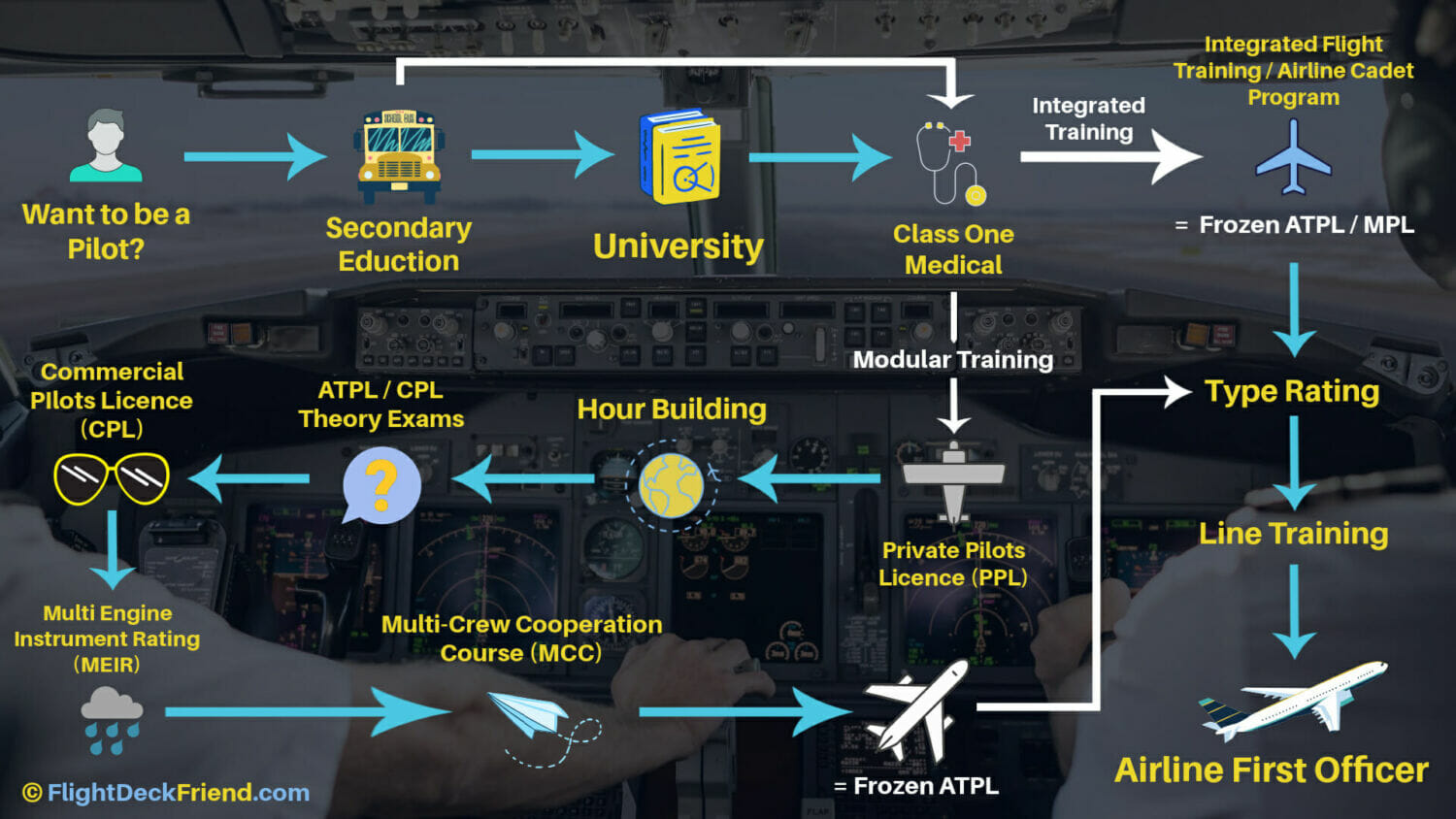
*Upset Prevention & Recovery Training (UPRT) is now also a requirement to hold a frozen ATPL
Related Pages:
 Shutter StockHow Long Does it Take to Train as a Pilot?
 Shutter StockPilot’s Licence Revalidation & Renewal
 ShutterstockHow Much Does It Cost to Train as a Pilot?
 Pilot Job Prospects
 ShutterstockAirline Pilot Medical Requirements
 Pilot’s Licence Validation & Currency
 Shutter StockWhat Qualifications are Required to be a Pilot?
 Shutter StockPilot Uniform Guide: What do the Stripes Mean?